
Weekly Mortgage & Market Update
Another Rate Hike? What It Could Mean for Your Mortgage
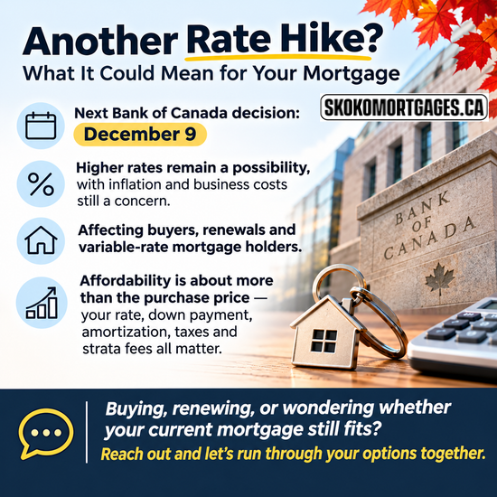
Last week, I talked about another Bank of Canada rate increase being back on the table. This week, that conversation continued—and if you’re buying a home, renewing your mortgage, or currently in a variable rate, it’s worth understanding what could come next.
The next Bank of Canada announcement is December 9. Another increase remains a possibility, but the decision hasn’t been made.
What happened this week?
In his November 24 speech, Bank of Canada Governor Tiff Macklem highlighted the risk that higher business costs could work their way into consumer prices.
Businesses have largely absorbed higher production and transportation costs so far. However, the Bank’s surveys suggest more of those costs could be passed along to consumers over the coming year, keeping inflation elevated. Macklem also noted that the economy has shown more resilience than expected.
That keeps further rate increases in the conversation. For borrowers, it’s a reason to review the numbers before building a mortgage plan around the assumption that rates will fall.
What does a quarter-point increase actually cost?
A rate headline can sound alarming. Putting dollars beside it makes the impact easier to understand.
Let’s use an illustrative variable rate of 4.30%, increasing by a quarter percentage point to 4.55%, with 25 years remaining and monthly payments that adjust with the rate.
| Mortgage balance | At 4.30% | At 4.55% | Monthly increase |
|---|---|---|---|
| $400,000 | $2,170 | $2,225 | About $55 |
| $500,000 | $2,712 | $2,781 | About $69 |
These examples apply to adjustable-payment mortgages. If you have a fixed-payment variable mortgage, your payment may initially stay the same while more goes toward interest and less toward principal. Payment changes and trigger provisions depend on your lender’s terms.
Locking in doesn’t mean keeping your current variable rate
This is the part that can catch people off guard. When you lock in, you’re converting your variable mortgage to a fixed rate offered by your lender. You aren’t freezing the variable rate you already have.
For example, suppose your variable rate is 4.30% and your lender offers a fixed conversion rate of 4.99%. On the same $500,000 balance with 25 years remaining, the fixed payment would be approximately $2,905 a month.
That’s about $193 more than the payment at 4.30%, and about $124 more than the payment after our hypothetical quarter-point increase to 4.55%.
In this example, the variable option still has the lower payment after one increase. That doesn’t tell us which option will cost less over the full term—future rate changes matter.
A fixed rate gives you certainty about your rate and principal-and-interest payment for the term. When the fixed offer is higher, that certainty comes at a higher starting cost. For some households, the peace of mind is worth it. Others have room in their budgets to handle changes and are comfortable staying variable.
Before converting, compare the actual fixed offer, the term you’d be committing to, and the mortgage’s flexibility and penalties.
Affordability is about more than the purchase price
A report released by TD Economics on November 26 found that Canada’s improving housing affordability trend has hit a setback. Higher borrowing costs contributed to worsening affordability in the second and third quarters of 2026.
For buyers in BC and Alberta, the practical reminder is simple: a lower purchase price doesn’t automatically mean a lower monthly payment.
Your mortgage rate, down payment, amortization, property taxes and any strata fees all affect what a home costs to carry. Before deciding whether to buy now or wait, look at how those numbers work together for your budget.
Buying or renewing? Review your options early
If you’re buying, refresh your pre-approval and make sure your payment estimates reflect the rates available to you. Ask whether a rate hold is available, how long it lasts and what conditions apply.
If your mortgage is coming up for renewal, start comparing options before the deadline. Look beyond the advertised rate to the payment, prepayment privileges, penalties and flexibility you may need.
Fixed mortgage rates are influenced by bond markets and lender pricing, so they can change before the Bank of Canada makes its next announcement. Waiting for December 9 doesn’t necessarily mean fixed offers will stay where they are today.
Have a plan before the next announcement
You don’t need to predict the Bank of Canada’s next move to make a sound mortgage decision. What helps is knowing what you can comfortably afford today, how a rate change could affect you, and which options fit your plans.
Let’s look at your numbers
Buying, renewing, or wondering whether your current mortgage still fits? Reach out and let’s run through your options together.
Payment examples are illustrations, not rate quotes or predictions. Calculations use monthly principal-and-interest payments, a 25-year remaining amortization and nominal annual rates compounded semi-annually. Payments are rounded and exclude taxes, insurance and fees. Actual variable-rate compounding, payment adjustments and conversion terms depend on the lender and mortgage contract.
Let's talk about your goals