
Weekly Mortgage & Market Update
Another Bank of Canada Rate Increase Is Back on the Table. What Does That Mean for Your Mortgage?
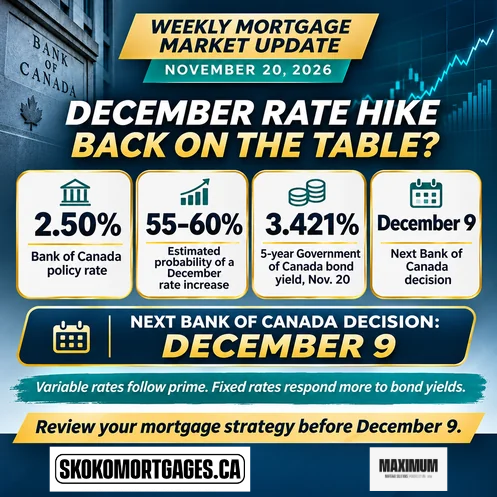
Just when many Canadians thought interest rates had stabilized, another Bank of Canada increase is back on the table.
Market expectations have shifted noticeably ahead of the Bank’s December 9 announcement. At the time of writing, several market based estimates place the probability of a quarter point increase at approximately 55% to 60%.
That is not a prediction or a guarantee. These probabilities can move quickly as new inflation, employment, spending, and economic data are released.
At the same time, Canada’s five year government bond yield closed at 3.421% on November 20. That was a meaningful decline from approximately 3.53% one day earlier and offers some potential relief from immediate fixed mortgage rate pressure.
One day does not establish a trend. Bond yields would need to remain lower before borrowers should expect lenders to make meaningful fixed rate reductions.
Variable mortgage holders are watching the Bank of Canada, while fixed rate borrowers still need to watch the bond market.
Those two parts of the mortgage market are connected, but they do not always move together.
December Is No Longer an Easy Hold
The Bank of Canada increased its policy rate by 0.25 percentage points on October 28, bringing it to 2.50%.
In its announcement, the Bank said inflation had become higher and more persistent than previously expected. It also acknowledged that another increase might be required, while emphasizing that future decisions would be made carefully.
Since then, markets have continued debating whether the Bank will increase the rate again in December or wait for more evidence.
The probability of an increase rose during trading on November 19 before easing somewhat. That movement illustrates an important point: market odds are a snapshot of current expectations, not a promise of what the Bank will do.
The Bank will receive additional information before December 9. Employment, inflation, consumer spending, business activity, energy prices, and developments outside Canada may all influence the decision.
My Take
Borrowers should take the possibility of another increase seriously, but they should not treat it as certain. A good mortgage plan should remain manageable whether the Bank increases the rate or leaves it unchanged.
Inflation Is Still Sending Mixed Signals
Canada’s Industrial Product Price Index increased 0.3% in October, while the Raw Materials Price Index declined 1.0%.
These measures track prices at different stages of the production process. Industrial product prices show what Canadian manufacturers receive for their goods, while raw material prices reflect the cost of inputs purchased by manufacturers.
The October results do not provide one clear inflation signal.
Higher industrial product prices suggest that some price pressure remains within the production system. Lower raw material prices could provide some relief if the decline continues and eventually reduces costs for businesses and consumers.
One report will not determine the Bank of Canada’s decision. Policymakers will consider whether price pressures are becoming broader, whether businesses are passing higher costs to customers, and whether inflation expectations remain under control.
Why Acting Early Is Part of the Conversation
The Bank of Canada recently published staff research examining how monetary policy should respond when a supply shock may be temporary or persistent.
The research found that responding early can sometimes produce a better result than waiting for complete certainty. If a shock proves persistent, waiting too long may allow additional inflation pressure to build and require a larger adjustment later.
There is an important distinction here.
This was an independent staff research article. It was not an interest rate announcement, an official forecast, or a signal that Governing Council has already decided to increase the policy rate in December.
It does, however, help explain why central banks may be cautious about assuming that new inflation pressure will disappear on its own.
My Take
The Bank does not want to overreact to temporary price increases, but it also does not want to wait until persistent inflation becomes firmly established. That tension is one reason the December decision remains uncertain.
Fixed and Variable Rates Are Telling Different Stories
One of the most common mortgage misunderstandings is that all mortgage rates move directly with the Bank of Canada.
Variable mortgage rates are influenced directly by a lender’s prime rate, which normally changes when the Bank of Canada changes its policy rate.
Fixed mortgage rates are influenced more heavily by government bond yields, lender funding costs, competition, risk, and lender pricing decisions.
The five year Government of Canada bond yield closed at 3.421% on November 20, down approximately 0.11 percentage points from the previous day.
That decline is encouraging for fixed mortgage borrowers because sustained decreases in bond yields can reduce lender funding pressure. However, lenders do not necessarily adjust their mortgage pricing immediately or by the same amount.
The yield also remains elevated compared with earlier periods. Borrowers should therefore view Friday’s decline as a positive development, not a guarantee that fixed mortgage rates are about to fall.
A Bank of Canada increase would affect variable borrowers more directly. Fixed mortgage rates might also move, but their direction would depend on how bond markets interpret the Bank’s decision, inflation outlook, and future economic conditions.
A Bank of Canada increase does not automatically mean every fixed mortgage rate will rise by the same amount.
What This Means for Variable Mortgage Holders
If the Bank of Canada increases its policy rate by 0.25 percentage points in December, lenders would normally increase their prime rates by the same amount.
For borrowers with an adjustable payment variable mortgage, the required payment would generally increase.
For borrowers with a fixed payment variable mortgage, the payment may remain unchanged, but more of each payment could go toward interest and less toward principal. The exact result depends on the mortgage contract and whether the borrower is approaching a trigger rate or another contractual adjustment.
Variable borrowers should review how another increase would affect their payment, amortization, and monthly budget before the December announcement.
What This Means for Fixed Rate Borrowers
Borrowers considering a fixed mortgage should not assume that waiting for the Bank of Canada’s decision will automatically produce a better fixed rate.
Bond markets may react before the announcement as investors adjust their expectations. Lenders may also change pricing based on funding costs, competitive pressures, and their own lending targets.
If you are buying, refinancing, or renewing soon, securing a rate hold may provide protection while you compare the available options. If eligible pricing improves before closing, a lower rate may sometimes be requested, subject to the lender’s policies.
The interest rate is only one part of the mortgage. Prepayment options, penalties, portability, restrictions, and the ability to refinance or transfer the mortgage may also affect its total cost.
If Your Mortgage Is Renewing
A renewal decision should not be based entirely on a prediction about December.
The better approach is to compare multiple scenarios.
- What would your payment be with a short fixed term?
- What would it be with a longer fixed term?
- How would a variable mortgage perform if the Bank increased rates again?
- Could you comfortably manage that higher payment?
- How much flexibility might you need before the end of the next term?
Starting the renewal review early gives you time to compare lenders and make a deliberate decision instead of accepting the first offer because the deadline is approaching.
Final Thoughts
The mortgage rate outlook is not moving in one simple direction.
Inflation risks are keeping another Bank of Canada increase on the table. The November 20 decline in the five year bond yield provides some potential relief for fixed mortgage borrowers, but that movement needs to continue before it is likely to produce meaningful lender rate reductions.
This does not mean everyone should rush into a fixed mortgage or avoid a variable mortgage.
The right strategy depends on your budget, risk tolerance, financial plans, timeline, and ability to manage a higher payment if rates move again.
Prepare for more than one possible outcome instead of building your mortgage strategy around a single prediction.
The next Bank of Canada decision is December 9. Until then, the most useful step is to understand how each possible outcome would affect your mortgage and household budget.
Review Your Mortgage Before the December Decision
If you are buying, renewing, or refinancing in British Columbia or Alberta, I can help you compare the available options and build a mortgage strategy around your goals and comfort level.
Sources
This article is provided for general educational purposes and reflects information available as of November 20, 2026. Market probabilities can change at any time and do not represent a Bank of Canada forecast or guarantee. Mortgage rates, products, payments, and eligibility vary by lender and borrower qualifications. Speak with a qualified mortgage professional before making a financing decision.
Let's talk about your goals